Here's a question worth asking at your next leadership meeting: if we couldn't use the office tomorrow, what would stop?
Then ask the same about the main system going down for three days. A key supplier failing. A third of the team off sick in the week before your busiest season.
It's not a question of if one of these happens. It's which, and when.
Business continuity isn't an IT problem
When people hear "business continuity", they often think of backups and disaster recovery. Those matter. But most disruptions aren't technology failures, and even the ones that are don't stop at the technology.
A burst pipe stops a team working, not just a server. A supplier going under stops a process. Illness stops people. The question isn't "how do we restore the systems?" It's "how does the business keep going while things are broken?"
Start with what matters most
You can't protect everything equally, and you don't need to. Start by listing what the business actually does - taking orders, shipping, supporting customers, paying staff, paying suppliers, invoicing - and for each one ask:
What happens if it stops for an hour? A day? A week?
Some things barely matter for a week. Monthly reports can wait. Others hurt within hours: if customers can't place orders, you're losing sales and soon losing customers.
The ones that hurt fast are your critical processes. For each, write down the longest it can stop before it does real harm. That number drives everything else.
Ask the people who do the work, not just their managers. They know what's really critical, and they usually know the workarounds that already exist.
For each critical process, four questions
- What does it need? The people, the systems, the suppliers, the place.
- What's the workaround? How it keeps going - even badly, even on paper - if those aren't there. Orders taken by phone on paper forms. Payroll repeated from last month and corrected next month. Pick lists printed from the last backup.
- Who owns it? One person, and a deputy, who'll make the workaround happen on the day.
- What comes back first? The recovery order, agreed now - not argued about while everything is down.
Write the workarounds down, and try them
A workaround that only exists in someone's head isn't a plan. Write each one down, step by step, somewhere people can reach without the systems that are down.
Keep what they need: paper forms, printed contact lists for customers and suppliers, a couple of spare laptops, a mobile hotspot.
And try them - for an hour, before you need them for a day. You'll find out what's missing while it's cheap to fix.
Know your key suppliers
Most businesses depend on a handful of suppliers they can't work without: the main software vendor, the internet provider, the payment processor, the carrier. For each:
- What would stop if they failed?
- Do they have a continuity plan of their own? Ask to see it.
- Is there an alternative, and how fast could you switch?
- Do they hold your data, and could you get it back?
Decide who decides
When something happens, someone needs to decide whether it's a bad morning or a continuity event - and then lead. Decide in advance who that is, and who stands in if they're away.
Agree how you'll reach each other if email and the office are both unavailable. Personal mobiles and a group chat outside your company systems are usually enough.
Telling people
Staff need to know they're safe, where to work and what to do. Customers need to hear what's affected before they find out another way. Suppliers may need to deliver somewhere else. Your insurer will want to know early, and you'll want receipts for everything.
Write down who tells whom, and how, if normal channels are down.
Practice once a year
Pick a scenario - the building flooded, a key supplier hacked, a sickness wave before peak season - and walk through it around a table for forty-five minutes, plan in hand. Note every gap: a missing number, a workaround nobody knew, a decision nobody owned.
The bottom line
The companies that come through a disruption well aren't the ones with the most money or the newest systems. They're the ones that decided in advance what matters most, how long it can stop, and how they'd keep it going until it's back.
Want it written down? The Business Continuity Plan is an editable plan with critical processes, workarounds, the recovery order and scenario cards - plus a guide to building and practicing it.
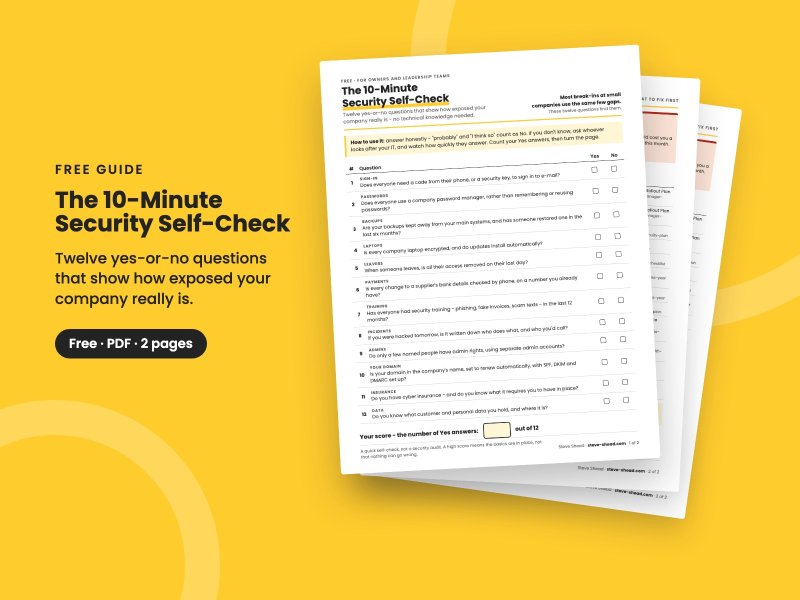
Free guide: The 10-Minute Security Self-Check - twelve yes-or-no questions that show how exposed your company really is.
Related reading
- The First Hour of a Cyber Incident: What to Do, and What Not To
- Every Organization Has a Sarah (And Why That's a Problem)
Not sure what would stop if your business were disrupted tomorrow? Let's talk. Finding out on paper is far cheaper than finding out on the day.

Comments
No comments yet - start the conversation.
Log in to join the conversation.
Log in Create an account