
Most IT budgets are built the same way: take last year's number, add a few percent, and hope.
Then the year happens. A software renewal comes in twenty percent higher. A project goes live and leaves new subscriptions behind. The cloud bill creeps. By the third quarter, the budget and reality have parted company, and the conversation with finance is about explaining the gap rather than deciding anything.
It doesn't have to work like that.
Start from last year's actuals, line by line
The best guide to next year is what you actually spent this year - not what you budgeted, what you spent.
List every line: each subscription, each contract, each person, each project. Next to each one, write last year's actual and this year's number. The difference is where the conversation is. A line going up by more than a few percent deserves a sentence of explanation before anyone asks for it.
And give every line an owner: someone who can say why it's there, and what would happen if it wasn't.
The costs that usually get missed
Budgets rarely go wrong on the big obvious lines. They go wrong on the ones nobody wrote down:
- Renewal increases. Many software contracts allow price rises at renewal, and some go up automatically. Check every renewal date and every cap.
- Running costs left behind by projects. A new system usually brings new subscriptions, support and hosting. The project budget ends; those costs don't.
- Growth in seats. More staff means more licenses, laptops and accounts.
- Hardware on a cycle. Laptops and network equipment age out on a schedule. If a third of your laptops are four years old, the refresh is next year whether it's in the budget or not.
- Security and compliance. Insurance premiums, penetration tests, audits, training. These keep rising, and they're easy to forget until a customer asks for the report.
- The cloud bill. It's usage-based, so it grows with the business - and with waste.
Run, grow or transform
Split the budget three ways:
- Run: keeping today's business running. Licenses, hosting, support, replacing what wears out.
- Grow: improving or expanding what you already do.
- Transform: new capabilities or big changes.
If most of the budget is "run", there's very little left to improve anything, and that's worth knowing - and showing. It turns "why is IT so expensive?" into a better question: "how much of this is just keeping the lights on, and is that the right balance?"
Plan the months, not just the year
Annual payments and project costs are lumpy. If you only budget the year, a big renewal in March and a laptop refresh in September look like overspending in those months and underspending in the rest.
Spread each line across the months it's actually paid: monthly, quarterly, or once a year in a given month. Then the budget and the bank account tell the same story.
Track it every month
A budget you don't track is a wish.
Each month, put the actuals next to the budget, line by line. Look at the year to date, not just the month. And keep a simple forecast: what you've spent so far, plus the budget for the rest of the year. If lines are running over, the forecast tells you early - while there's still time to decide what to do about it.
A word on benchmarks
Technology spend as a share of revenue, or per employee, is a useful sanity check. It's a poor target. It varies enormously by industry, size and how much of your business runs on technology. Compare yourself with last year more than with anyone else.
The conversation with your CFO
What builds trust isn't a lower number. It's no surprises.
A CFO can work with a budget that's higher than they hoped, if every line has an owner and an explanation, the big changes are called out up front, and the actuals are reported every month. What they can't work with is a number that was fine in January and wrong by August.
The bottom line
A good IT budget isn't a forecast. It's a set of decisions: what you're paying for, why, and who's responsible for each line - tracked every month so the decisions stay honest.
Want a head start? The IT Budget gives you the budget by category and month, the run, grow and transform split, actuals against budget, and a forecast for the year.
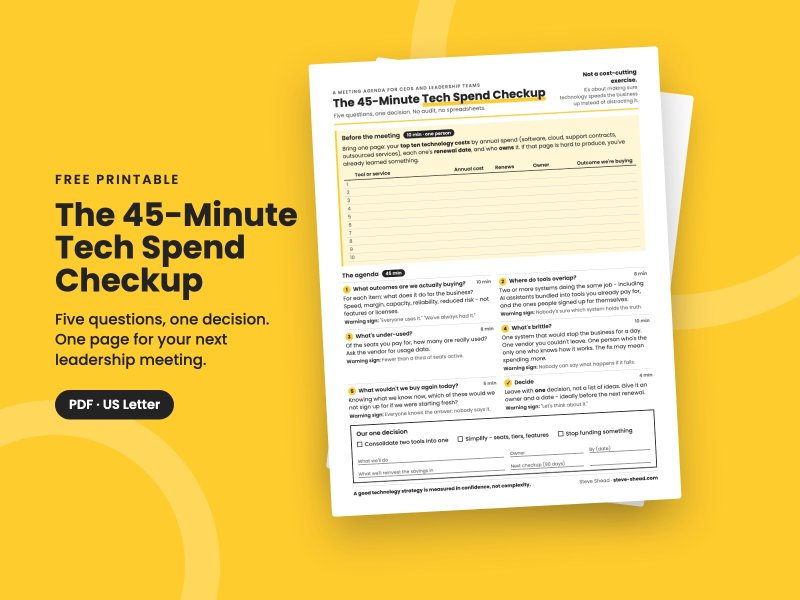
Free guide: The 45-Minute Tech Spend Checkup - a one-page meeting agenda for finding out whether your technology spending is working.
Related reading
- The 45-Minute Tech Spend Checkup Every CEO Should Run
- Why Your Cloud Bill Keeps Growing (and How to Cut It Without Breaking Anything)
Building next year's technology budget? Let's talk. A second pair of eyes before it goes to the board is usually worth it.



Comments
No comments yet - start the conversation.
Log in to join the conversation.
Log in Create an account