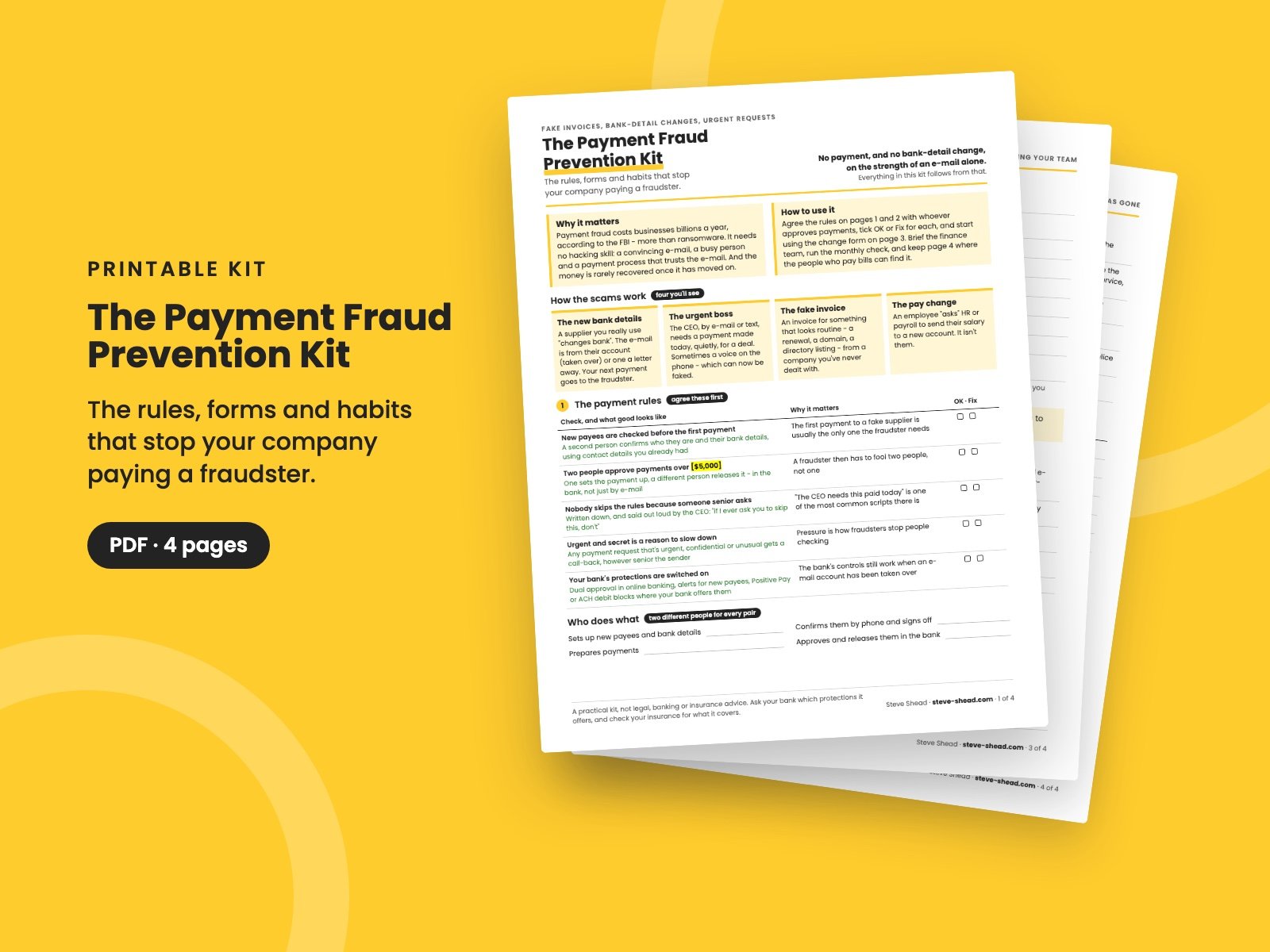
The Payment Fraud Prevention Kit
Stop fake invoices, bank-detail change scams and "urgent" payment requests from the boss: the payment rules, a bank-detail change form, red flags, a 10-minute finance-team briefing, a monthly check and what to do in the first hour if money has gone.
Payment fraud costs businesses billions a year, according to the FBI - more than ransomware. It takes no hacking skill. A supplier you really use "changes bank", or the CEO needs a payment made today, quietly. The e-mail looks right, someone busy pays it, and the money is gone before anyone notices.
The fix isn't technology. It's a few rules everyone follows, every time - starting with this one: no payment, and no bank-detail change, on the strength of an e-mail alone.
What's in it
- How the scams work: new bank details, the urgent boss, the fake invoice and the pay change - the four you'll see.
- The payment rules: checking new payees, two people for larger payments, nobody skipping the rules because someone senior asks, and your bank's own protections.
- Bank-detail changes: why they never change on an e-mail, the call-back on a number you already had, and watching the first payment.
- E-mail and accounts: multi-factor sign-in, the forwarding rules fraudsters hide, and making your domain hard to fake.
- Red flags that mean "call before you pay".
- The bank-detail change form: one per change, signed off by two people - and the question to ask on the call that a fraudster can't answer.
- Briefing your finance team: a 10-minute script, including what the CEO needs to say out loud.
- The 20-minute monthly check, the questions to ask your bank, and if money has gone: the first hour, step by step, and who to call.
Who it's for
Owners, CEOs, finance leads and office managers at small and growing companies - anyone who pays suppliers, runs payroll or can release money from the company's bank account.
Practice it with the payment fraud drill in The Tabletop Exercise Kit, and see what your insurer expects with The Cyber Insurance Readiness Checklist. If an e-mail account was taken over, The Incident Response Plan covers the rest.
It's a practical kit, not legal, banking or insurance advice.
It's a 4-page PDF, made to print and write on.
Want them all? The Complete Collection has every guide in the store in one download, for less than a third of the price.
Reviews
No reviews yet.
Bought this? Log in to review it.
Log in