The Data Map and Privacy Checklist
Find out what personal data you hold, where it is, who can see it and how long you keep it, then cover the privacy basics and answer people's requests on time.
"What personal data do we hold, and where?" It sounds like a simple question. At most companies, nobody can answer it.
Customer details live in the CRM, the order system, the email platform and somebody's spreadsheet. Employee records are split between the HR system and a shared drive. Job applications sit in someone's inbox. Some of it is sensitive, some is kept forever, and some is with suppliers nobody has checked.
You can't protect data you don't know you have, delete what you don't need, or answer someone who asks what you hold about them. This workbook starts with that map.
What's in it
- The Data Map: one row for each kind of personal data. It records whose it is, whether it's sensitive, why you hold it, where it's kept, who can see it, who it's shared with, which country it's in, how long you keep it, whether it's deleted when due, whether it's encrypted, when access was last reviewed, and who owns it. It flags every gap and rates each row High, Medium or Low.
- Privacy Basics: 20 things most privacy laws expect, in plain terms. They're grouped by area: know your data, tell people, keep it safe, keep only what you need, respond to people, and when it goes wrong. Mark where you are, and give anything that isn't Yes an owner and a date.
- Requests: a log for when someone asks to see, correct or delete their data, with the deadline worked out and anything due soon or overdue flagged.
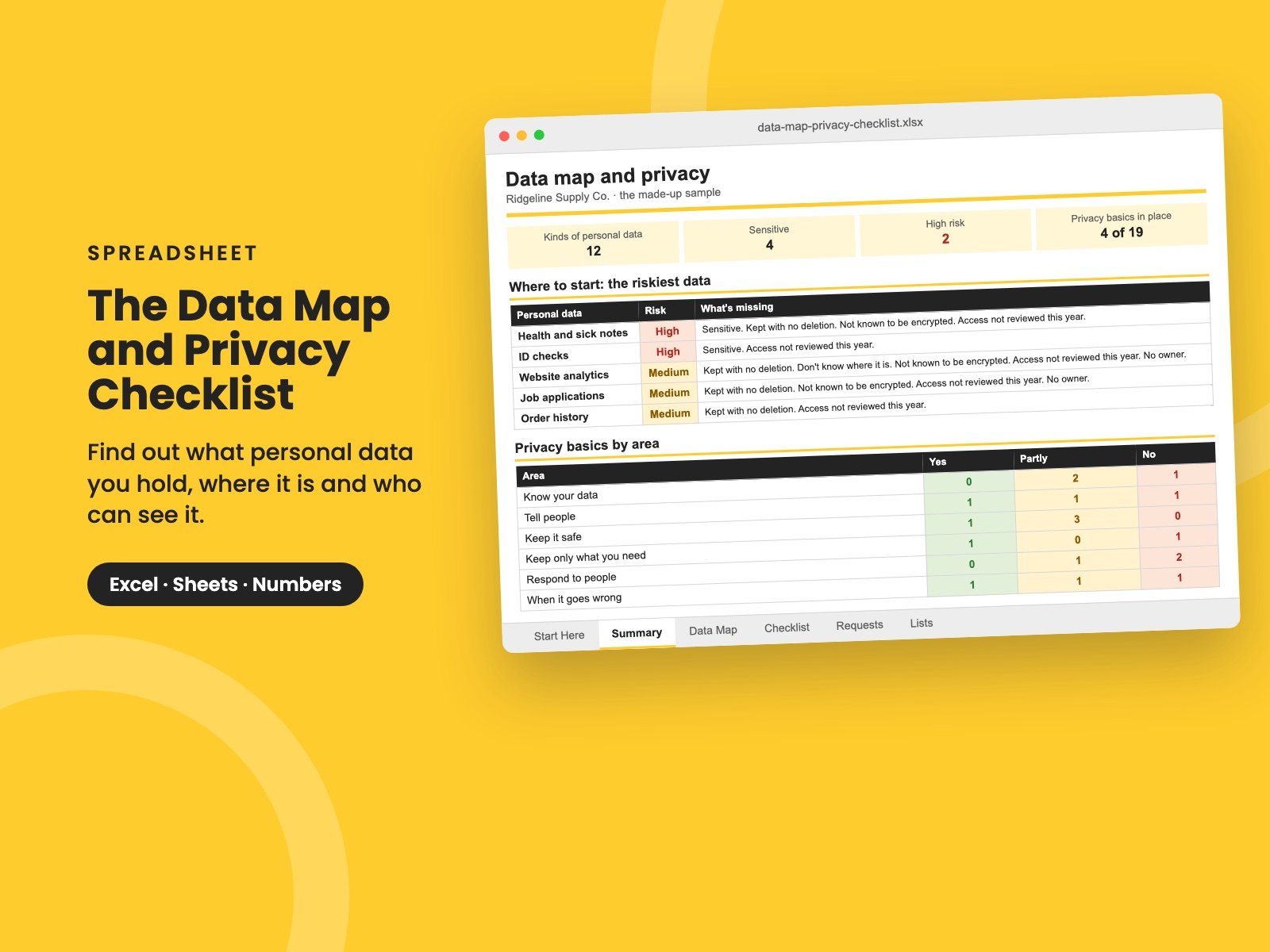
- Summary: the totals, the privacy basics by area, and the riskiest data, so you know where to start.
It comes filled in with a made-up company, whose riskiest data turns out to be sick notes in a shared folder. Clear the sample and the formulas stay.
Who it's for
Owners, CEOs, HR and IT leaders at growing companies who've never mapped their personal data, and anyone facing a customer's privacy questionnaire, an audit or due diligence.
It pairs with The Tech Due Diligence Checklist and The Incident Response Plan.
It isn't legal advice. Which privacy laws apply to you depends on where your customers and staff are, so check with a lawyer, especially for health, financial or children's data.
It's a single Excel file. It also opens in Google Sheets and Apple Numbers.
Want them all? The Complete Collection has every guide in the store in one download, for less than a third of the price.
Reviews
No reviews yet.
Bought this? Log in to review it.
Log in