Most conversations about AI start with tools.
Which platform. Which model. Which vendor. Which features.
But when a leadership team tells me they want an "AI strategy," what they usually want is relief. Relief from long queues of manual work. From slow decisions. From systems that don't talk to each other, and from processes that only work because a few people perform small heroics every day.
That's a reasonable thing to want. But you won't get it by starting with the tools, because of one simple fact:
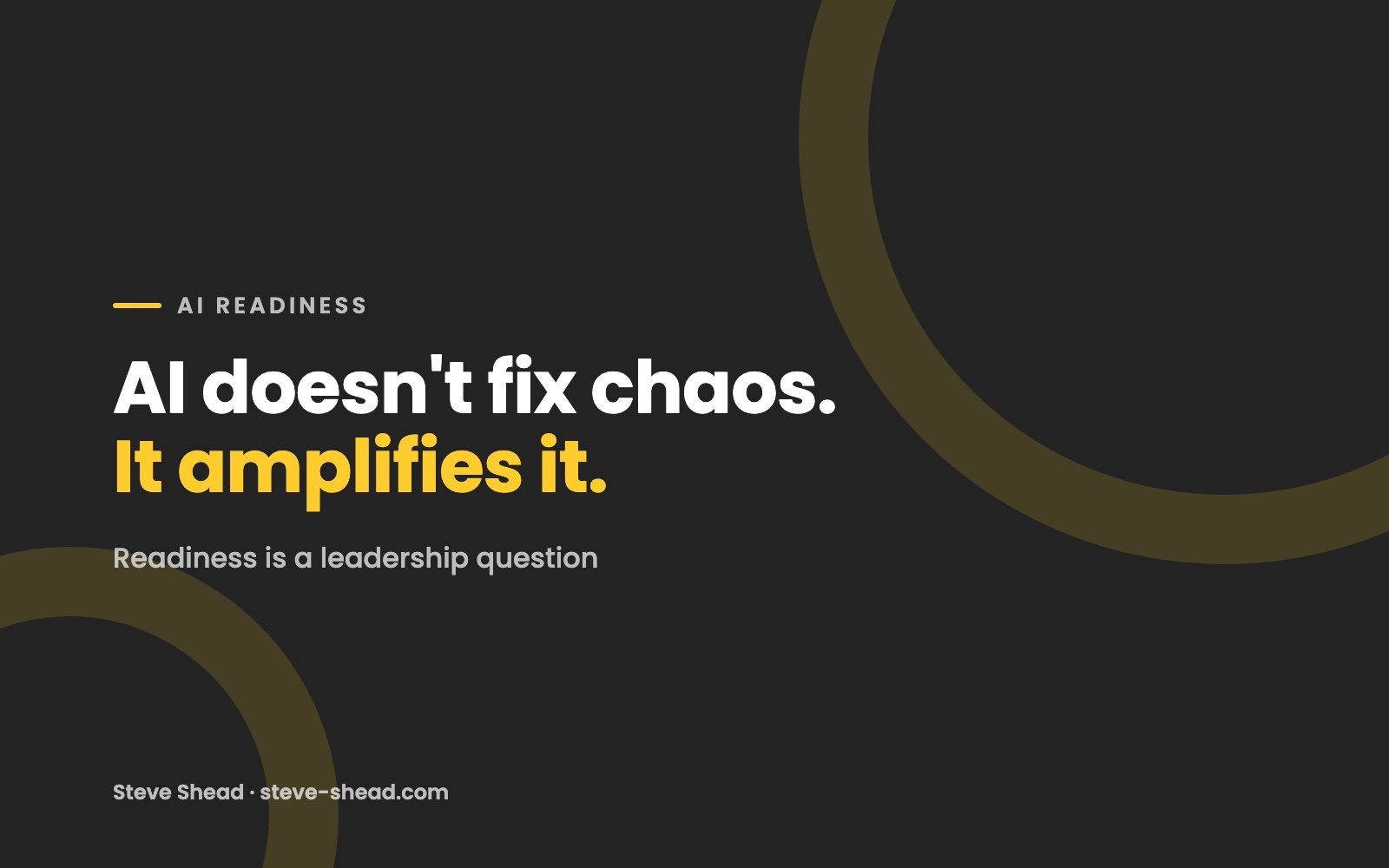
AI doesn't fix chaos. It amplifies it.
Point AI at a clear process with good data and accountable owners, and it makes that process faster. Point it at a messy one, and you get the same mess - faster, at scale, and with more confidence than it deserves.
So AI readiness isn't really a technology question. It's two other questions: a leadership one and an operational one.
The leadership question
AI forces a kind of clarity most organizations have been able to avoid. Before any tool goes live, someone needs to be able to answer:
- What decisions are we willing to delegate? Drafting an email is not the same as approving a refund, which is not the same as rejecting a loan application.
- What risks are we willing to accept? A wrong answer from an internal assistant is an inconvenience. A wrong answer sent to a customer is a liability.
- Where does accountability live when a system is involved? "The AI did it" is not an answer your customers, auditors or board will accept.
- What data can these tools see? Many organizations discover their file permissions were wide open only when an AI assistant starts surfacing documents nobody was meant to find.
- Who owns AI here? Not who's excited about it - who's accountable for it.
If those answers aren't explicit, AI doesn't create efficiency. It creates confusion. It accelerates judgment, amplifies assumptions and exposes everything that was never clearly defined.
That's why implementation is the easy part. The hard part is governance, ownership, and deciding what should be automated rather than what merely can be.
The operational question: start with friction
Once leadership has answered those questions, the most effective approach I've seen is to stop thinking about AI for a moment and think about friction instead.
1. Find the real points of friction.
Not the symptoms - the root causes. Where do people lose time? Where do customers lose patience? Where does a process break down and need a person to rescue it? Ask the people doing the work; they know.
2. Simplify before you automate.
A broken workflow executed faster is still a broken workflow. Remove the steps that exist only because of an old system, an old policy or an old argument. Simplicity is the highest form of scalability.
3. Automate what should never have needed a person.
If skilled people spend hours pulling data, reconciling reports or copying between systems, that isn't real work. It's friction disguised as effort. Much of this doesn't need AI at all - plain automation and better integration will do it, more cheaply and more predictably.
4. Then bring in AI where it reduces cognitive load.
Summarizing, drafting, searching, triaging, spotting patterns. The best AI implementations don't feel like AI. They feel like invisible support that lets people spend their time on judgment instead of busywork.
A quick readiness check
You're in a good position to get value from AI if you can say yes to most of these:
- We know which processes cause the most friction, and why
- Our core data is reasonably clean, and we know where it lives
- Access permissions reflect who should see what, not who once needed it
- We have a written policy on which AI tools staff can use, and with what data
- One named person is accountable for AI decisions and risk
- We've agreed how we'll measure success - time saved, errors reduced, customers served - before we start
- A human is clearly responsible for every decision that affects a customer
If most of those are no, that isn't a reason to wait. It's your starting list - and working through it will pay off whether or not you ever deploy an AI tool.
The shadow AI problem
One more thing: if you haven't decided on AI yet, your staff almost certainly have. People are already pasting work into free assistants because it helps them, and they'll keep doing it until there's a better, approved option.
Banning it rarely works. Giving people a sanctioned tool, clear guidance on what data is off limits, and someone to ask works much better - and it tells you where the real demand is.
Start small, on purpose
AI strategy isn't a destination. It's a maturity curve. The first step isn't choosing a model; it's choosing one painful process, simplifying it, and proving that a well-placed tool makes life genuinely better for the people involved and the customers they serve.
Small steps taken deliberately will always outperform big initiatives taken reactively.
And when AI is done well, it doesn't replace thinking. It demands better thinking - which, in the end, is a leadership job.
Related reading
- CTO or CIO? How to Tell Which One Your Company Actually Needs
- The Security Questions Every Executive Should Be Able to Answer
Wondering where your organization really stands? Let's talk. An honest readiness conversation usually saves far more than it costs.

Comments
No comments yet - start the conversation.
Log in to join the conversation.
Log in Create an account